"Computers are useless. They can only give you answers."
~Pablo Picasso
Does your use of instructional technology substantially improve what students learn or
how they learn it?
In the broadest sense, instructional technology has tremendous potential to improve student learning. But technology can also interfere with learning when increased screen time replaces effective teacher-led instruction, discussion, collaboration, and guided practice. The social facets of learning are irreplaceable. So the question becomes not whether schools should use technology, but rather when technology should be used because it substantially improves teaching and learning.
It is time to reexamine our instructional technology practices in the ever-changing educational landscape. The SAMR Model of instructional technology integration has been a prevailing framework over the past decade.
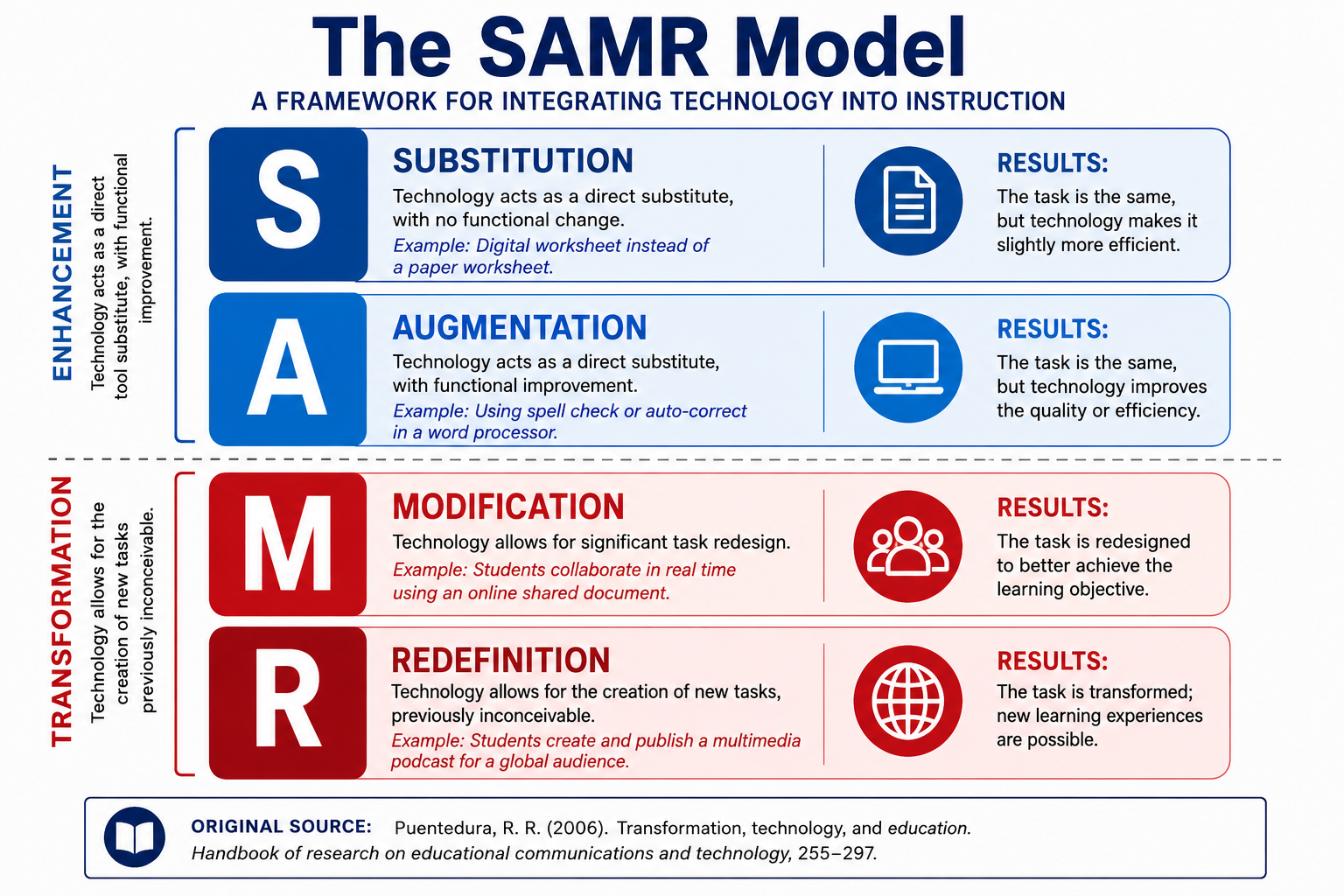
At first, instructional technology use was encouraged at the Substitution and Augmentation levels as a way to gain a foothold in the classroom, while Modification and Redefinition were considered the ultimate goals. Unfortunately, the model evolved into a ladder – or incremental continuum – for instructional technology integration. In reality, the levels are mutually exclusive and independent of one another.
Screen Time and the Unintended Outcome of Instructional Technology
Schools have invested heavily in instructional technology: one-to-one devices, digital curricula, digital textbooks, learning platforms, and more. Students increasingly experience learning as:
- Log in.
- Put on headphones.
- Complete the assigned module.
- Submit.
- Move to the next activity.
Technology gradually shifted from being an instructional support to becoming a primary means of delivering instruction. Efficiency and individualization are valuable, but independent software work is not synonymous with effective instruction.
Classroom Technology and Screen Time Practices to Re-examine
- Assigning students extended periods during the school day to work individually on a technology-driven learning pathway without a teacher actively leading the activity. Effective instruction requires an actively engaged teacher.
- Having students work individually on devices when the task is better suited for collaborative student interaction. Instead, structure the activity around groups of students sharing a single device.
- Purchasing online curricula designed for students to progress incrementally and independently through material each day. Instead, use such materials to support classroom presentations, teacher-led instruction, and guided learning.
- Allowing students to work on devices while the teacher sits at a desk disengaged from the learning process.
A Course Correction: The SHIFT to a More Strategic Approach to Instructional Technology.
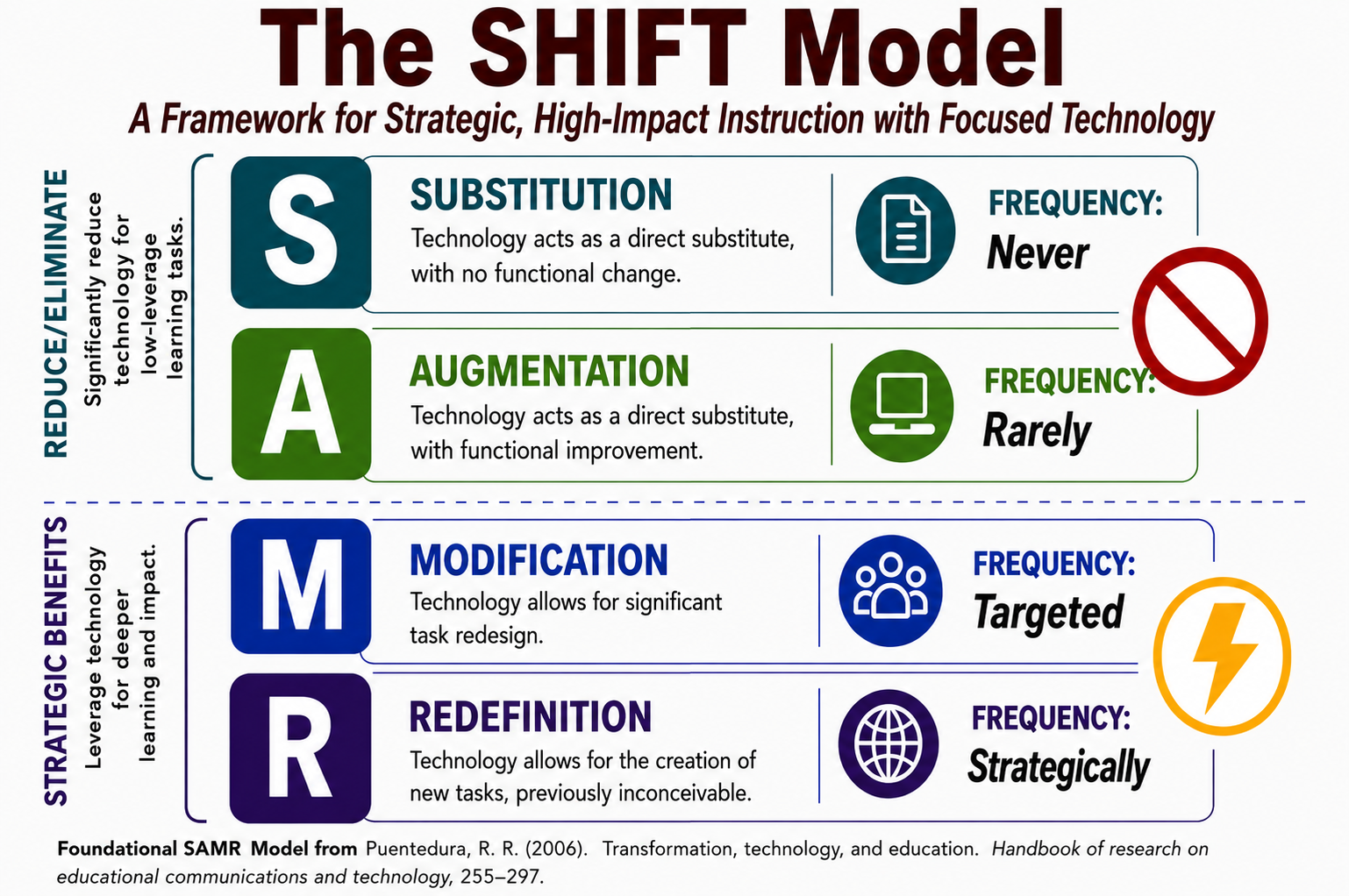
It’s time for a SHIFT in instructional technology use. Technology no longer needs to gain a foothold in the classroom. Instructional technology is already abundantly available and deeply embedded in today’s classrooms. It is now time to harness its power more effectively and strategically.
We need to “bring teaching back” through strategic, high-impact classroom instruction supported by focused, purposeful use of instructional technology. Eliminate or significantly reduce the use of technology when it merely substitutes for or slightly augments more traditional instructional methods. Reclaim teacher-led instruction at each of these levels.
Effective Teacher-Led Classroom Instruction
We would be hard-pressed to find a technology solution that can outperform a highly effective classroom teacher implementing any of the following research-based best practices:
- Positive teacher-student relationships.
- Explicit/direct instruction.
- Modeling and think-alouds.
- Formative assessment and checks for understanding.
- Immediate feedback.
- Purposeful questioning.
- Classroom discussion and academic discourse.
- Scaffolding.
- Flexible small-group instruction.
- Differentiation based on observed student needs.
(Hattie et al., 2023)
Using Instructional Technology in a Supporting Role
The power of instructional technology lies primarily in the “M” and “R” levels of the SAMR Model. At these levels, technology is strategically focused on areas where it can support the classroom teacher in enhancing student learning. From the best-practice strategies listed above, technology can strengthen instruction when applied in a focused, limited, and purposeful manner. For example:
- Small-group instruction using a single device on which students work collaboratively.
- Immediate feedback during formative assessment, such as a five-minute check for understanding.
- Differentiated, individualized interventions of limited duration with expert teacher oversight.
Guiding Question for Lesson Design
Every teacher and school leader should be asking the same question: Does technology substantially improve what students will learn or how they will learn it?
If NO:
Consider teacher-directed instruction, discussion, paper-and-pencil tasks, manipulatives, collaboration, guided practice, or other non-device approaches.
If YES:
Use the technology intentionally to achieve the intended improvement.
The future classroom does not need to choose between teachers and technology. A more purposeful, blended model is Teacher → Technology → Teacher
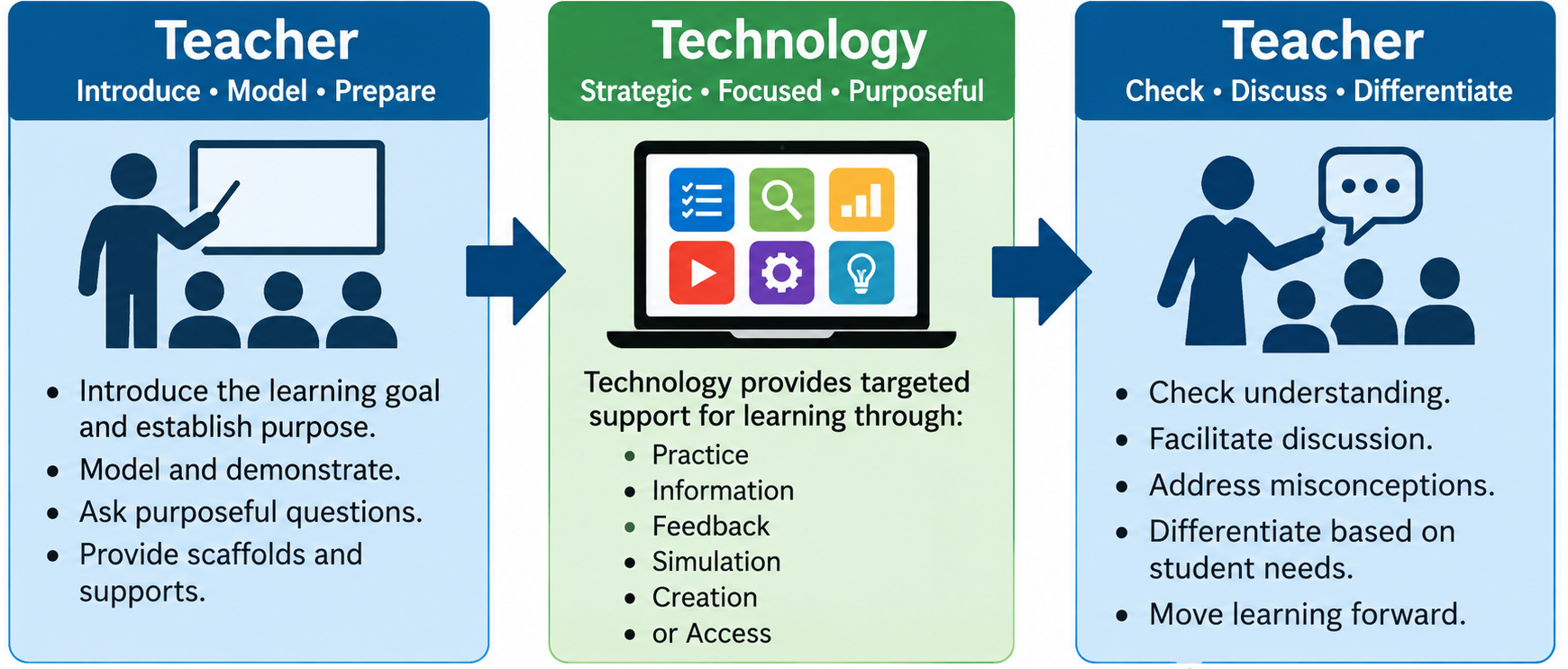
- The teacher introduces, models, questions, scaffolds, and establishes purpose.
- Strategic, focused technology use provides targeted practice, information, feedback, simulation, creation, or access.
- The teacher then checks for understanding, facilitates discussion, addresses misconceptions, differentiates, and moves learning forward.
Back to the Essential Question:
Does your use of instructional technology substantially improve what students learn or how they learn it?
The goal is not to eliminate technology from classrooms. The goal is to become more intentional about when technology adds instructional value—and when direct teacher instruction, discussion, collaboration, and guided practice are more effective.
Less low-value technology. More high-value teaching. Position technology as an instructional tool in the teacher’s hands, not as an instructional destination for students.
Less screen time. More teaching.
Use technology less often, but use it more powerfully. Replace passive or routine screen time with active instruction, meaningful interaction, and purposeful learning.
“Technology is just a tool. In terms of getting the kids working together and motivating them, the teacher is the most important.”
~Bill Gates
Want to explore how the SHIFT can help teachers reduce low-value screen time while using technology more strategically?
Join our free Inspired Webinar.
References:
Fifield, W. (1964). Pablo Picasso: A composite interview. The Paris Review, 32, 37–62.
Gates, B. (1997, October 12). Interview in The Independent on Sunday.
Hattie, J., Fisher, D., & Frey, N. (2023). Visible learning: The sequel. Corwin.
Puentedura, R. R. (2006). Transformation, technology, and education. Handbook of research on educational communication and technology, 255-297.