"Kids don’t learn from people they don’t like." ~ Rita Pierson
Student engagement in the classroom is a much-discussed element of effective and successful instruction. Yet defining “student engagement” and measuring it remain nebulous at best. There is no shortage of ideas, models, and articles on the topic. Much of the discussion revolves around incorporating instructional best practices that tend to increase student engagement. While these ideas are worthy of discussion and implementation in the classroom, they often circumvent accurate measurement and clear articulation of the multiple facets of student engagement.
It is as if the definition of student engagement mirrors Supreme Court Justice Potter Stewart’s definition of another vague topic in 1964—we rely on the notion of “I know it when I see it” to define and measure student engagement.
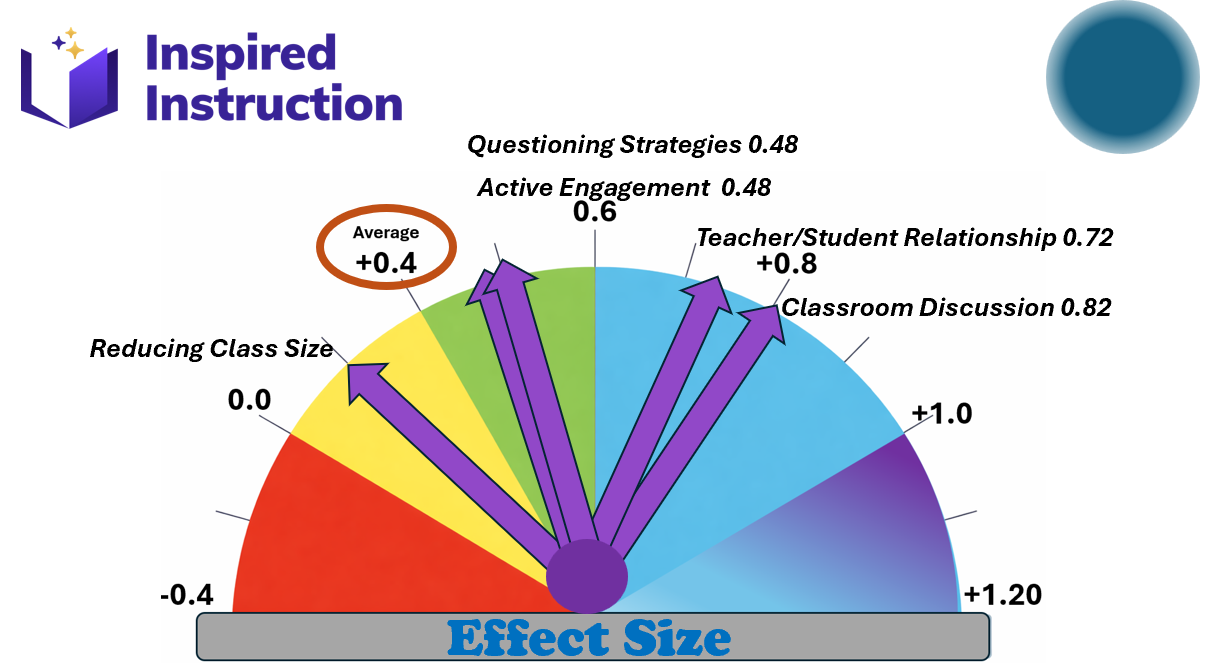
Interestingly, a review of the literature reveals a similar lack of consensus. Hattie’s effect size for “Active Engagement/Active Learning” is 0.48—above the average effect size of 0.40—yet he notes that one of the difficulties with measuring student engagement is that it is poorly defined. Additionally, components of engagement such as participation and motivation are foundational to the success of most other instructional strategies.
Consider questioning strategies and classroom discussion. Questioning strategies have an above-average effect size (0.48), but classroom discussion has a significantly higher effect size (0.82). Now add the confounding factor of student engagement. Is student engagement necessary for questioning and discussion to be effective? Or are impactful questioning and discussion strategies necessary for student engagement to occur?
Spoiler alert: I don’t plan to answer this conundrum. Instead, I propose that we need both impactful, research-based instructional strategies and a better way to measure student engagement through a common model and language. That model must include clearly defined facets of engagement that are easily identified through classroom “look-fors.” If we cannot measure student engagement, how can we meaningfully discuss and improve it?
Therefore, the remainder of this discussion focuses on a “measuring stick” for student engagement, leaving specific strategies for another time.
Essential Question:
What metric are you using to measure student engagement in the classroom?
Schlechty’s Stages of Engagement
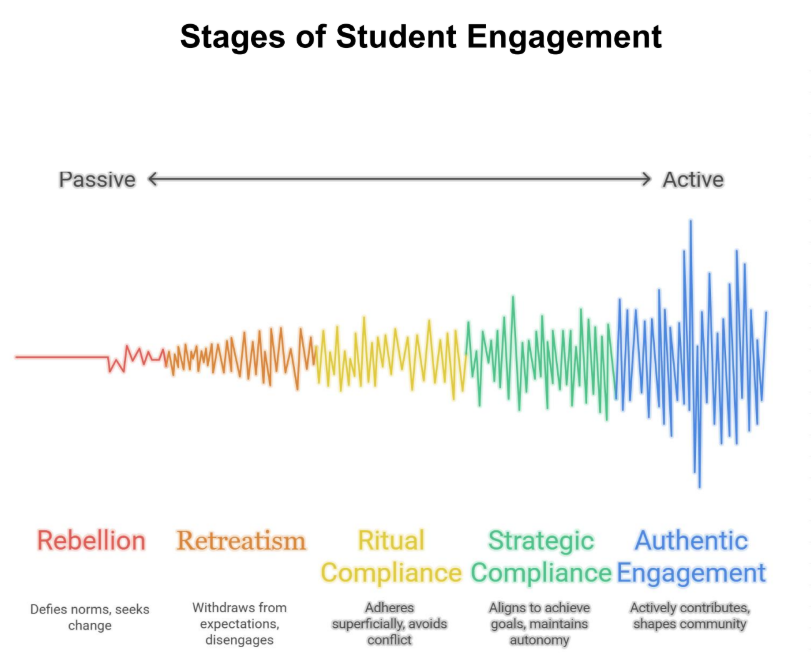
For years, my “go-to” student engagement model has been Phillip Schlechty’s five stages:
- Authentic Engagement
- Strategic Compliance
- Ritual Compliance
- Retreatism
- Rebellion
(Schlechty, P. C. (2002). Working on the Work: An Action Plan for Teachers, Principals, and Superintendents (1st ed.). Jossey-Bass.)
These five stages resonated with me based on my years of experience as a math teacher.
The Rebellion Stage
Rebellion is self-explanatory. Students in this stage reject, ignore, refuse, or challenge school and classroom expectations. These students are often overtly disruptive—to other students and to the learning process itself.
The achievement of all students may be jeopardized by those in this stage, yet the individual student still deserves the teacher’s best effort and the support of school resources. Such students present one of a teacher’s greatest challenges: balancing the needs of one with the needs of the whole.
The goal here is simply to identify the attributes of students in the Rebellion Stage. The causes and solutions deserve far more attention than space permits.
I leave you with one of my favorite quotes:
“If some students are unresponsive , maybe you can’t teach them yet, but you can love them. And if you love them today, maybe you can teach them tomorrow.” ~ Anonymous
Don’t give up on them!
The Retreatism Stage
A student in the Retreatism Stage is not rebellious or disruptive. Instead, they are quiet and largely noncompliant when it comes to classroom tasks and activities. Apathy best describes these students’ approach to learning.
I recall a standardized report card comment that read: “Indifferent attitude toward learning.”
Interestingly, students in this stage are not exclusively quiet and disconnected. This group also includes social and outgoing students who avoid meaningful participation in learning. Homework and studying? No. But what are you wearing to the pep rally tonight?
The root causes of this disengagement are complex and likely similar to those in the Rebellion Stage, though manifested differently. Again, building positive relationships is the starting point.
The Ritual Compliance Stage
Ritual Compliance is marked by avoidance of negative consequences. Students attend school and complete homework to avoid getting in trouble. They believe simple participation is sufficient to achieve educational goals.
This mindset is sometimes shaped at home and influenced by an older, manufacturing-style mentality: do what is required, move along the conveyor belt, and success will follow.
Passivity is a key characteristic. If the conveyor belt moves, they move. If it stops, they stop. Either way, they are content.
In my opinion, Ritual Compliance—second only to Strategic Compliance—requires deeper examination when addressing achievement challenges in today’s classrooms.
The Strategic Compliance Stage
Strategic Compliance is often mistaken for Authentic Engagement, but a significant difference exists.
Strategic Compliance centers on short-term extrinsic rewards. Students are motivated by grades, honor roll status, and adult praise. They believe that excelling within the system of rewards will lead to future success.
There is certainly a correlation between academic achievement and future opportunities. However, students in this stage are often more pleased with a curved test or extra credit than with deep understanding of content.
In my opinion, this group includes students who later withdraw from future educational pursuits despite appearing well-prepared. Strategic Compliance can stand in the way of Authentic Engagement, depth of understanding, and critical and creative thinking.
The Authentic Engagement Stage
The highest level in Schlechty’s model is Authentic Engagement. Students at this stage demonstrate self-motivation, excitement, and genuine interest in deepening their understanding of the world.
However, Schlechty’s definition of Authentic Engagement lacks clarity, making it difficult to distinguish from Strategic Compliance. Educators attempting to measure engagement are again left with Justice Stewart’s “I know it when I see it” approach—or by process of elimination.
Blah.
Kagan (and Reeve) to the Rescue
Kagan’s model defines student engagement across three dimensions:
- Behavioral
- Cognitive/Intellectual
- Social
(Kagan, S. (2009). Kagan Cooperative Learning. Kagan Publishing.)
Reeve adds a fourth:
- Agentic
(Reeve, J. (2012). A self-determination theory perspective on student engagement. Handbook of Research on Student Engagement. Springer.)
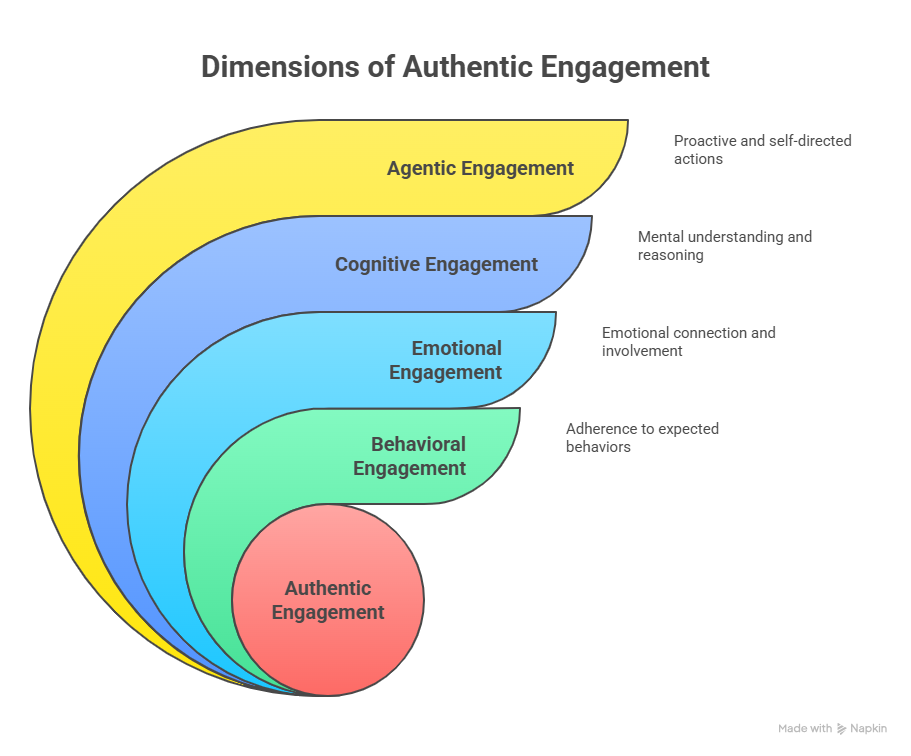
In my opinion, Kagan—amended by Reeve—fills the void in Schlechty’s model by better defining Authentic Engagement through four overlapping dimensions. However, Kagan’s model does not clearly define disengagement or noncompliance at the lower end of the spectrum.
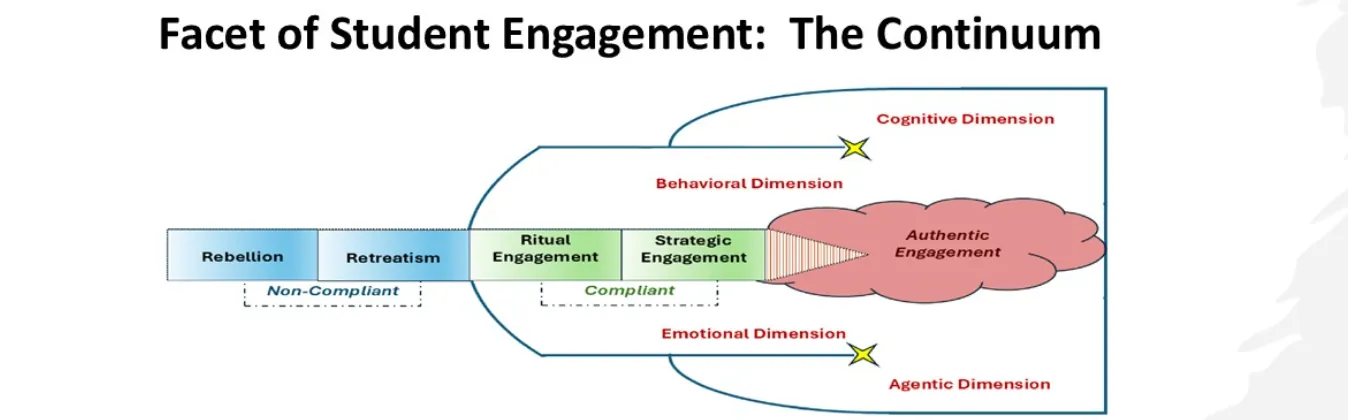
Therefore, I propose merging both models into a comprehensive continuum. Schlechty’s stages form the central engagement continuum. As the continuum approaches Authentic Engagement, elements of Kagan’s Behavioral and Emotional dimensions emerge. At Authentic Engagement, all four dimensions—Behavioral, Emotional, Cognitive, and Agentic—overlap and operate concurrently.
This synthesis provides clearer “look-fors” for measuring student engagement in observable ways.

Behavioral Dimension - “What are they doing?”
Attributes of the Behavioral Dimension are “necessary but not sufficient” for Authentic Engagement. This dimension is marked by many overlapping measures in the compliant phase of the continuum in the Ritual and Strategic stages such as attendance, completing assignments, and participating as required.
Social/Emotional Dimension - “How are they feeling?”
The Emotional Dimension’s attributes of Authentic Engagement include motivation and positive attitude overlapping with those in the Strategic Stage on the continuum. However, it extends further to include relationships, physical and emotional safety, and a sense of belonging. Existing research is clear on such effective elements as the underpinning of student achievement in the classroom.
Again, the Emotional Dimension alone is necessary but not sufficient for Authentic Engagement.
Cognitive Dimension - “At what level are they thinking?”
Here, Authentic Engagement truly takes shape.
Critical and creative thinking dominate this dimension as students increase depth of understanding. Questioning, initiated by both teachers and students, leads classroom discussions at the higher end of Bloom’s Hierarchy. Students not only can explain complex content but can also apply and interpret situations from multiple perspectives.
If we can identify these attributes in the classroom, Authentic Engagement has been achieved.
Agentic Dimension - What are they curious about?”
The capstone of this continuum is the Agentic Dimension.
Often left out of the discussion, this elusive dimension is marked by students improving their personal experience and taking ownership of their learning. Instead of being prompted by teacher-initiated activities, students at this level proactively question and explore a broader and deeper spectrum of understanding related to classroom content.
Teachers become partners instead of leaders, as they themselves explore areas unfamiliar to them. Think Zone of Proximal Development. Constructivist Piagetians would be proud.
Next Step Essential Questions
This discussion has not focused on specific strategies to increase engagement. Instead, it has proposed a common language and model for measuring and articulating engagement data.
Once that foundation exists, we can address root causes and identify improvement strategies.
I leave you with the below essential questions to ponder:
- What instructional strategies foster authentic engagement?
- How do we capitalize on student behavior characteristics of the Ritual and Strategic Stages to facilitate a shift to the Cognitive and Agentic Dimensions of Authentic Engagement?
- What are common root causes of students in the Rebellion and Retreatism Stages?
- Is there a benefit to differentiating engagement strategies?
And after all of this, I believe Rita Pierson captured it best: “Kids don’t learn from people they don’t like.”
At its essence, engagement involves a relationship.
In the classroom, relationships are multifaceted: peer relationships, teacher-student relationships, relationships with content, and relationships with school as a whole.
Often we overcomplicate things—as I may have done here.
Fostering student engagement in your classroom might begin with a simple “smile and hello” to individual students throughout the school day as we acknowledge their need to be seen.
___________________________________________________________________________
For more in depth information on advancing student engagement in the classroom, join Inspired Instruction's Client Director, Dhara Patel, on March 18th at 1:00PM EST for her upcoming webinar, Student Engagement That Works: Strategies for Immediate Impact.