In my years working with teachers, I have heard a lot about including discourse into lessons. “My kids can’t have small group discussions. They are always off task.” “They won’t talk to each other.” “They just can’t handle unstructured activities like collaborative groups.” “I don’t have time for discussions. I have to do the curriculum.”
Interestingly, both Maryland and District of Columbia systems have literacy standards that specifically address speaking. Standard 1 of the Speaking and Listening Standards for both systems emphasize student participation in “ collaborations with diverse partners, building on others' ideas.” (Maryland College and Career Ready Standards, DC Standards of Learning/Common Core)
Despite the fact that speaking standards in both Maryland and the District of Columbia clearly indicate that students should be having instructional conversations with each other, these discussions often are not taking place. There are reasons why teachers avoid student to student discourse and seem to be wedded to the practices that they have always used. Teachers frequently rely on practices that are comfortable and are meant to help maintain students’ focus. There is also the perception that if the teacher is talking, the students must be learning. These practices and beliefs can result in lessons that do not include strategies that research has shown have a positive impact on learning.

As I reviewed information about the impact of student talk in classrooms, I discovered some interesting things.
- Research shows that teachers talk an average of 70 to 80 percent of the class. Experts believe that, optimally, students should be the ones talking 70 to 80 percent of the time.
- Teachers ask an average of 200 - 300 questions each day. Students average about 2 questions each day.
- Research has found that there is a positive impact when students get to discuss what they are learning with each other. In his groundbreaking work, John Hattie (2012) found that classroom discussion had an effect size of .82. This puts student discourse in the category of “practices that yield desired results” (strategies that accelerate student learning.)
- A research study in 2019 found a strong relationship between the frequency and quality of student conversations and student performance on reading tests. (Sedova, K, et. al, 2019)
- Research has consistently shown that talking is a vehicle for thinking. Students who talk more in class are better able to analyze information, think critically, and create meaningful connections that support their learning.
In short, the more time we let students talk and engage with others about their learning, the better their academic performance. We also have to acknowledge, though, that it is difficult for teachers to find the time to practice using new strategies that might take them (and their students) out of their comfort zone.
What can we do about this?
- Start Now! There is no time like the present! These last few weeks in the school year are the perfect time to try new things, explore new strategies, and add routines to teacher toolboxes, so that they are ready to be used in the fall. State testing is all but over, and spring fever is hitting students hard. Something new would be good for everyone.
- Lead by example. Teachers will be more willing to try new strategies in their classrooms if they have the opportunity to experience the practices themselves. Introduce strategies during staff meetings or professional development sessions, so teachers can experience the activities from the students’ point of view.
- Provide a support structure that encourages taking risks. Teachers are more likely to try something new if there is a process in place to support them taking risks. Provide assistance as teachers plan for and implement new strategies. Provide opportunities for informal, non-evaluative feedback and reflection.
What would this look like?
- Consider the meeting topic and choose a discourse strategy. Select a low-risk, easy to implement, and universally applicable strategy that will allow participants to
- Introduce the meeting content. Review the meeting outcomes and agenda. Set the stage for the discussion process.
- Explain the strategy. Provide a clear rationale for the strategy and an explanation of how it works.
- Implement the strategy. Engage teachers in active learning by processing the content individually and collaboratively.
- Debrief the process. Ask teachers to reflect on the following questions individually and then share their ideas collaboratively.
- How did this strategy help you process the content individually?
- How did this strategy help you collaborate with others and hear diverse perspectives?
- How did this process help you extend, clarify, validate, or transform your own thinking?
- What are some ways you could use this strategy (or a variation of it) in your classroom?
- Provide next steps. Outline future classroom implementation. Remind teachers of support systems to help them be successful.
- Arrange classroom visits. Visit classrooms as teachers are implementing the strategy to provide informal feedback and support.
- Engage in follow-up reflections. During a follow-up PLC meeting, ask teachers to reflect on their use of the strategy: What went well? What needs to be upgraded? What was the impact on student engagement and learning?
Can you provide a specific example?
Meeting Topic: Examining data from a climate survey to inform school improvement planning for the upcoming year.
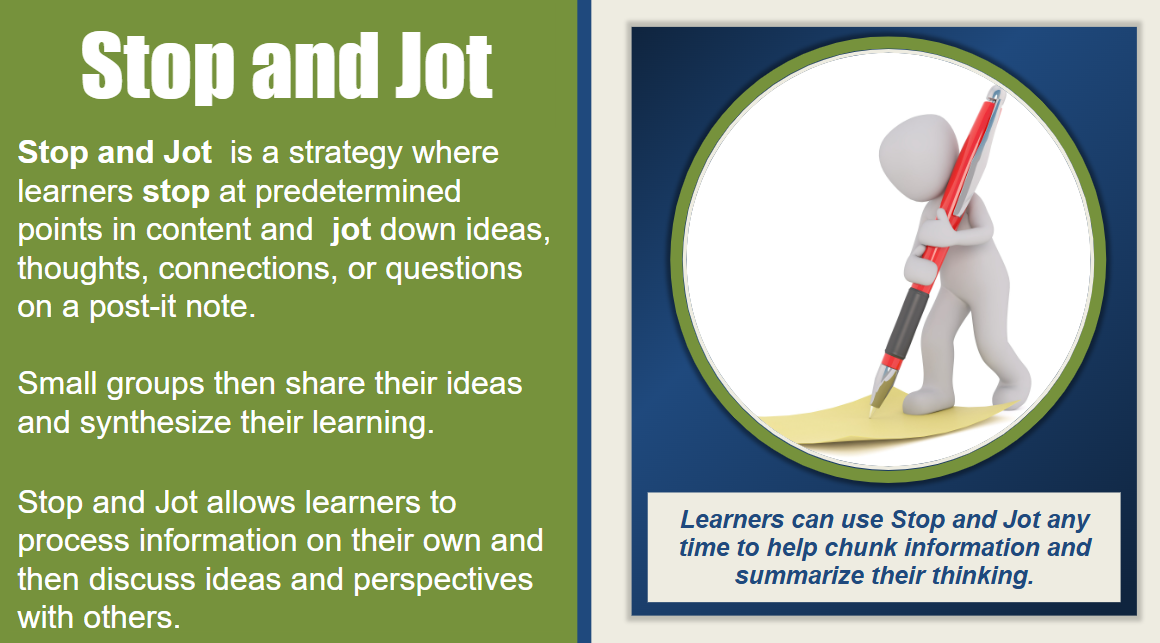
Discourse Strategy: Stop and Jot. With this strategy, learners stop at predetermined points in content and jot down ideas, thoughts, connections, or questions on a post-it note. Small groups then share their ideas and synthesize their learning.
Meeting Facilitator: “Take a few minutes to review the first section of the survey about Classroom Climate. After you review that section stop and jot down any ideas, thoughts, connections, or questions that you have about the data you reviewed. If you have more than one idea, put each one on a separate post-it.”
Provide participants several minutes to complete the data review and their post-its.
Meeting Facilitator: “Now that you have reviewed the data and jotted down some of your ideas, you will share your post-its with the rest of your table group. As a group, identify one idea that you feel is the most important learning for us as a school about that section. Write your group’s idea down on a new post-it. We will collect these to use for school improvement planning.”
Provide table groups time to talk about their ideas. This process would be repeated for any other sections on the survey.
Meeting Facilitator: “Today we used Stop and Jot to process the information from the survey. Stop and Jot helps individuals monitor their own comprehension, hear ideas from others, and make decisions as a group about important ideas learned. This strategy can be used across content areas and grade levels. Let’s take a few minutes to debrief the Stop and Jot strategy.”
_____________________________________________________________________________________
During my research I came across the following quote that, to me, says it all.
"The person doing the talking is the person doing the learning."
- Jen York-Barr, author and educator
As educational leaders in Maryland and DC, we need to recognize speaking as a critical learning standard and provide students the opportunity every day and across all content areas to use discourse as a way to elevate their academic success.
______________________________________________________________________________________
Resources
DC Standards of Learning/Common Core
Gerwetz, C. How Much Should Teachers Talk in the Classroom? Much Less Some Say, January 2020.
Hattie, J. Visible Learning for Teachers, 2012.
Mayland College and Career Ready Standards
Sedova, K. , Sedlacek, M., Svaricek, R., Majcik, M., Navratilova, J., Drexlerova, A., Kychler, J., Salamounova, Z., Do those who talk more learn more? The relationship between student classroom talk and student achievement, Learning and Instruction, V. 63, October, 2019.