"A community grows greater when people plant trees in whose shade they know they shall never sit.” ~ Greek Proverb
I’ve struggled over the years to find a comparison for the relationship between schools and their community that helps educators shift their mindset to a more parent-, family-, and community-centered approach. Unfortunately, some existing perceptions of schools are that they are unapproachable government agencies with rigorous rules, policies, and procedures. “Comply as directed…” Such mindsets ultimately hinder the goals of our schools and the needs of students, parents, and the larger community.
The best comparison I have come up with is that our schools are similar to hospitals:
“Good schools are to students and their parents as good hospitals are to patients and their families.”
So think for a moment—if a family member had to be admitted to the hospital, would you choose one hospital over another? If so, why? And if you had a family member in the hospital, how would you want their experience to go?
Now replace “hospital” with “school” and ask yourself the same questions. The answers are remarkably similar in a broader sense. Few want to be in the hospital, just as many don’t want to be in school. Both require necessary participation to achieve a desired outcome. I will skip further details on the analogy; those wanting more can ask their favorite AI app to “compare what parents want from their child’s school and what patients want from hospitals.” The results are very interesting.
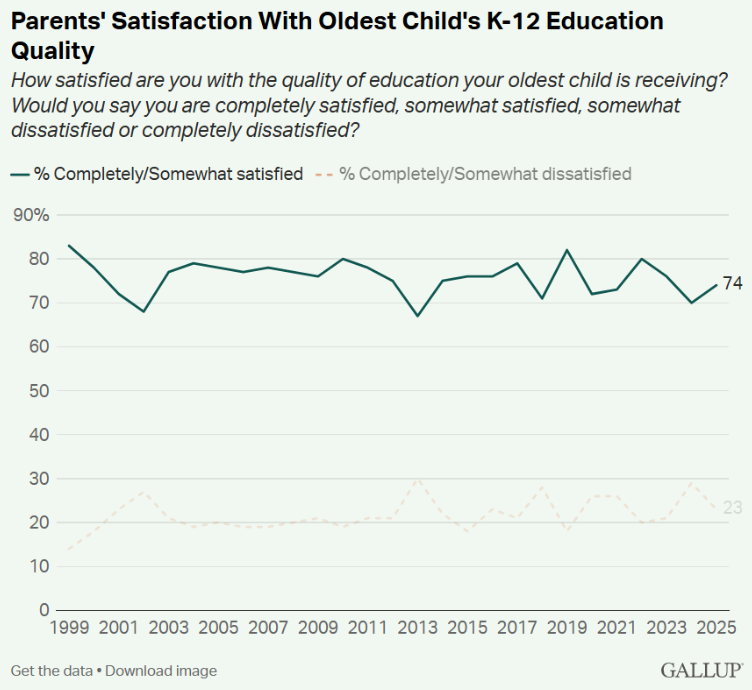
Let’s flip the discussion from “what parents want from school” to “what we, as educators, want parents to say about their child’s school.” Just like hospitals, a good school is part quality and part perception. Past Gallup annual surveys show that parents perceive their local schools to be of better quality than they perceive the nation’s schools in general. Perception might trump actual quality.

So let’s view parents and the community as spokespersons for our school. What do we need them to say at the neighborhood picnic about us?
- “My child will be successful at our school.”
- “My child has more opportunities than I had in school.”
- “Our schools are physically and emotionally safe places.”
- “I trust the leaders and staff at our school.”
- “I’m proud of our schools.” (Realtors advertise our schools.)
- “I’d give our schools a 5-star customer/parent service rating.”
If parents are saying these things about their schools, we have overcome a significant part of the challenge. This can only lead to positive gains in student experiences and substantive achievement outcomes.
So how do we foster such parent and community perspectives of our schools? When working with parents, each educator and school leader must have the dual mindset of an upscale resort customer service representative and a highly qualified doctor or nurse.
Cornerstones of Parent and Community Engagement
- Visibility and access to school leaders
- Trusted communication—early, regular, and proactive. Skip the jargon.
- Positive mindset
- Student-success oriented
- Parent-friendly services and hours
- Practical tools and resources for school and home
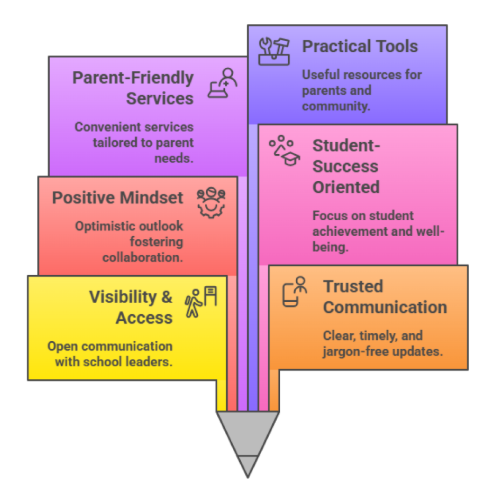
The cornerstones set a tone for your school: staff and leadership that promote trust, positivity, accessibility, and practicality. Each cornerstone is built over time under normal school operating conditions, as well as during celebratory and crisis situations. If your parent and community partnership is struggling, take a closer look at each of the cornerstones. Review your emails, newsletters, calls, and conversations. There will most likely be areas to fine-tune moving forward.
In my opinion, that’s the “big picture” of what parents want from their child’s school. I will save a more detailed discussion on each cornerstone for a future blog. This is a good exit ramp for those just looking for an executive summary of the topic. For those interested, I continue. (So much for brevity!)
A Deeper Dive into One of the Cornerstones: Practical Tools and Resources
Let’s go deeper with an example applying one of the cornerstones: “Practical Tools and Resources.” Parents do their best with the knowledge and resources available to them. As their partners in supporting their children—our students—we need to provide parents with options of tools and resources to that end. I stress the importance of “options,” as preaching and telling parents what to do and how to do it often produces the opposite of the intended results. If schools and their leaders adhere to the other cornerstones, parents will take your “ideas” as those of a trusted partner in supporting their parenting and their children’s future success.
One thing I’ve learned is that students are overloaded with information that is vast in quantity, poorly organized, and ineffectively communicated. (Honestly, I think adults are similarly overloaded as well.)
As a new high school principal with six assistant principals, 300 staff members, and nearly 3,000 students, I struggled to deliver a concise, coherent message about expectations. There were dozens and dozens of rules to follow, many procedures, interpersonal expectations, and more. I am fairly certain students heard only Charlie Brown’s teacher when adults spoke about such expectations. (Google it.)
Fortunately, over years of professional development, listening to others, and reading, I was able to reduce my expectations for students to four guiding principles, supported by an enduring understanding as the rationale.
Four Simple “Overarching Habitudes” That Expand Opportunities
Collectively, I believe the following four guiding principles can serve as an umbrella for a school, a family, an organization, or an individual to guide decision-making and troubleshoot situations that didn’t work out well. The first two are very specific and encompass all school rules and procedures. The next two principles are more general, addressing softer skills but linking directly to social-emotional and leadership initiatives.
“Be where you’re supposed to be when you’re supposed to be there.”
Why is this important? In school, if you and your classmates are where you’re supposed to be, it frees up teachers and principals from addressing the problem. This simple habit allows them to spend more time supporting your academic, social, and emotional success and working to make your school experience outstanding. You get to decide how adults spend their time—chasing you around, doing parent meetings, fixing attendance problems, or coordinating things that make your experience even better.
Outside of school, as an adult, this habit is a component of professionalism and an important employability skill.
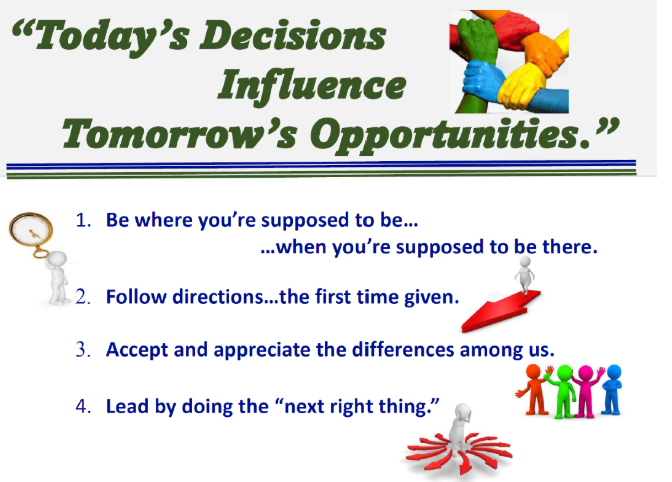
“Follow directions the first time given.”
I believe this principle came from Lee Canter’s classroom management work in the late 1980s.
Society is full of rules. Most have a history and a sound rationale, even if it has been long forgotten. Schools are no different. Rules exist for safety, security, structure, and organization. Admittedly, some rules are outdated. However, if we collectively follow directions in real time, the merits of those directions can be discussed or debated later.
In heated situations, even if directions haven’t been followed multiple times, following them—even once—can de-escalate the situation and allow for a calmer conversation later.
“Accept and appreciate the differences among us.”
We live in complicated times, but these situations present opportunities to understand different perspectives without necessarily agreeing with them. Accept that there are differing views on politics, religion, constitutional interpretation, cultural practices, football teams, sneaker types—the list goes on. Accept that differences exist, and appreciate the opportunity to better understand them.
Diwali is a great example, as more than one billion people—one-sixth of the world’s population—celebrate it. Accept that others believe in something different than you, and move toward appreciating that it is as important to them as your most important holiday is to you.
“Our differences are what strengthen our bond.”
“Lead by doing the next right thing.”
I heard this idea at a student council conference—though the movie Frozen popularized it!
Everyone is a leader in some way. Whether you lead a nation, a school, a business, a family, or a small group of friends, you are a leader. You don’t need a title to be a leader; in fact, most successful leaders are leaders long before earning a formal title.
Doing “the next right thing” is a way to practice leadership—one small step at a time. Not some monumental event, but a small moment where you choose what is right. You get to decide what “right” is in that moment.
Even after a series of poor decisions, the “next” decision can be the right one. Leadership starts with individual decisions stacked over time.
_______________________________________________________________________________________________________
The above is what I used in a large suburban high school setting and continue to apply in both my professional and personal life. If it resonates with you, your staff, or your family, there is a small poster attached—perhaps it finds its way into your school newsletter, refrigerator, or family bulletin board. Please use it freely or adapt it to meet your needs!