

The Status:
Literacy and numeracy are both fundamental skills of becoming a lifelong learner and productive citizen. Sadly, neither are guaranteed to all as part of the outcome of our education system. Millions leave school without these fundamental skills to access information involving text-based and numerical information. This is not to place blame on our education system or our education professionals, it is simply a statement of fact. The challenges faced by today’s educators are evident.
I will put innumeracy aside for a later time, and address literacy gaps: causes, consequences and solutions.
“21% have low literacy skills”
“54% read below the sixth grade level”
The Potential Causes:
I am a product of the Whole Language movement of teaching reading and writing. It didn’t work for me. The Whole Language approach was developed and implemented as a solution to what was then considered a decades-long failed approach of compartmentalized literacy instruction of vocabulary, phonics, grammar, sentence structure, etc. Then, came the Balanced Literacy phase which blended both previous approaches to literacy instruction. Balanced Literacy now competes with Structured Literacy which resembles the approach from the compartmentalized literacy instruction of decades ago (Yup, full circle…).
Unfortunately, again, these approaches have yet to demonstrate measurable results, despite mandated implementation in a number of states.
The literacy gaps are the persistent differences in reading and writing skills between different groups of people. More simply stated, the literacy gaps demonstrate a lack of proficiency in basic reading and writing skills across groups and individuals after exiting the nation's education system. This means that there is no guarantee a person will be able to read and write at a level sufficient to consume adult text and communicate effectively in writing.
Reasons, blame, and root causes are abundant, but not my focus. Research points to the belief that, if a child cannot read on grade level by grade 3, he/she never will. (Wennersten, 2013). That may very well be true but we should not stop trying to grow students’ reading skills through the middle level and, particularly, in high school. We seem to simply move on to topics such as reading the classics and Shakespeare, forgetting to review and continue to develop the fundamental skills to engage in such works of literature. I recall having to read Wuthering Heights as a senior in high school. Maybe it should have been called Withering Heights, as the only thing that was withering was me.
The Consequences:
The results of such broad literacy gaps could very well be the polarized world we live in today. Much information is conveyed in other forms such as memes, TikTok Videos, and sound bytes on TV; and it is not going away. There appears to be an aversion to consuming more complex text for a deeper understanding after experiencing the sound bytes. This is further underscored by an inability to communicate accurately and concisely in writing.
The consequences of the literacy gaps resonate when articulated using the Matthew Effect, a biblical reference (yes, that Matthew!) to the idea of those with more, gain more, while those with less will fall further behind.
In the literacy gap context, the gap compounds each year as limited vocabulary leads to weaker comprehension. Weaker comprehension results in less reading. And less reading results in slower growth and access to information. Less access to information reduces depth of understanding and communication skills. The cumulative effect of this cycle can be seen in the widening differences in literacy skills when disaggregated by state, ethnicity, socioeconomic status and other factors.
Potential Solutions
Of course, the answer always seems to lie with our overworked and overwhelmed educational professionals. Fortunately, in my opinion, the potential solutions aren't new or foreign to any of us.
: What works in the realm of literacy instruction?
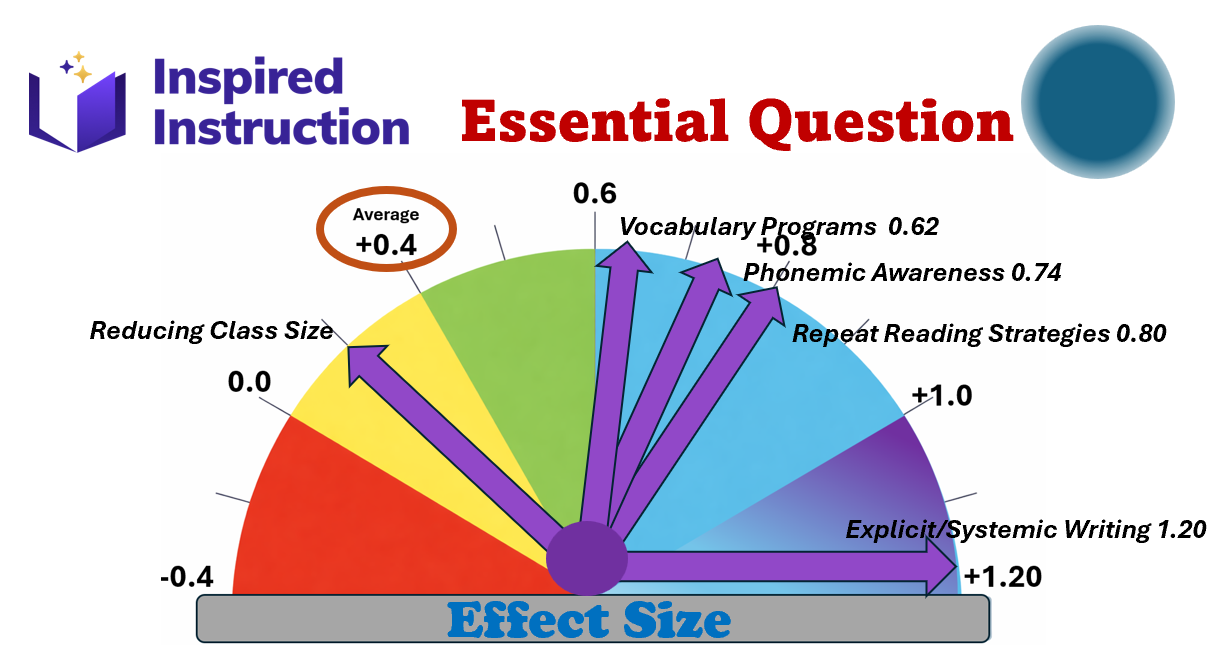
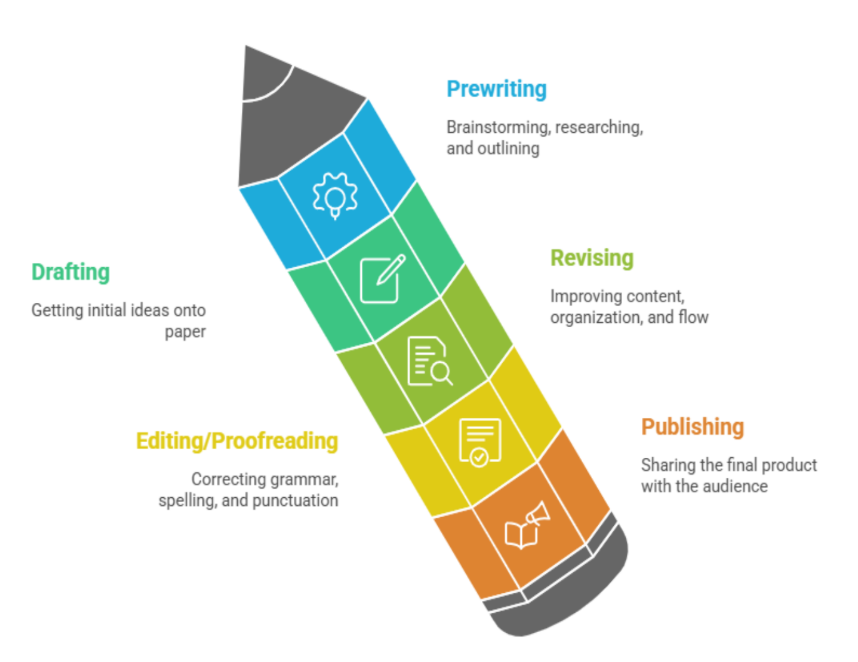
Basically, to shrink the literary gap, particularly in our secondary schools, we need to close the “Knowing vs. Doing Gap” about best practices in literacy instruction. Efforts to this end require leadership, learning, collaboration, and time. We know from existing research that explicit vocabulary, writing and reading strategies have effect sizes of well above average of 0.40 (Hattie, et. al. 2023). Specifically, “Explicit and Systematic Writing Strategies” (planning, brainstorming, editing, peer-revising and goal-setting) has an effect size of 1.20. On the reading end, phonemic awareness has an effect size of 0.75 with vocabulary programs and repeated reading at 0.62 and 0.80 respectively (Interestingly, Whole Language and Balanced Literacy approaches have a significantly lower effect size – 0.14).
Idea 1: Back to the Basics: Part-time
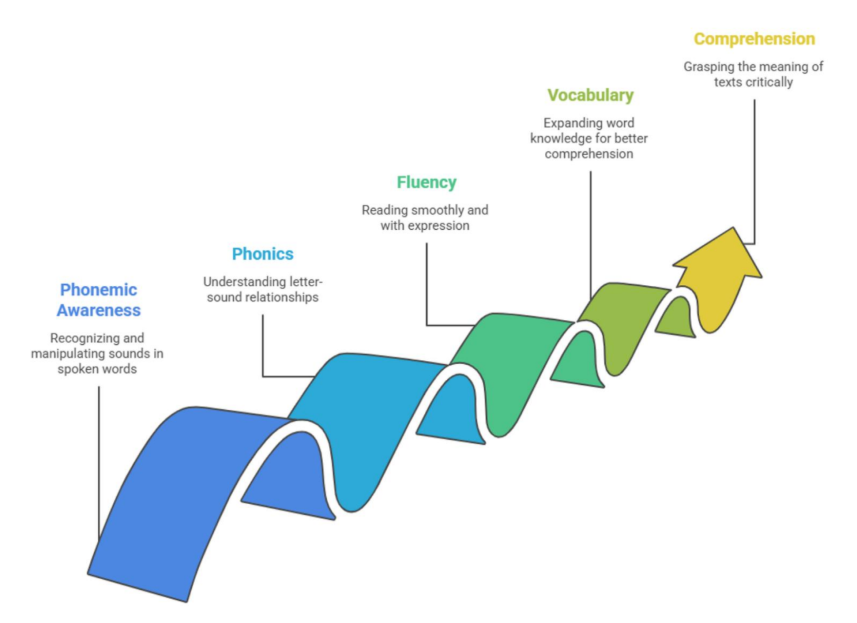
Back to the basics at all levels. Not full time. Not without some context. But back to explicit instruction on the fundamentals of reading:
- Phonics
- Phonemic Awareness
- Fluency
- Comprehension
- Vocabulary
First and foremost, what are the new reading concepts at each grade level? Articulate them; teach them with the fundamentals of reading; frequently assess for individual student attainment. Then, intervene to eliminate individual student deficiencies. Repeat. If that sounds a lot like MTSS Level 1 and Level 2—good!
Secondly, we have to identify those students who come to us at each grade level lacking necessary reading skills from previous grades, regardless of the cause of the deficiencies. Many may have transitioned from other schools or recently acquired the English language. Yup…MTSS Level 1 and Level 2 again. Yes, even in high school. A little less Wuthering Heights, andmore explicit phonics, fluency, comprehension, phonemic awareness and vocabulary work. Honestly, I could probably use a few lessons in the fundamentals of reading at this period in life.
Idea 2: Develop Common Reading/Writing Models and Languages Across Disciplines
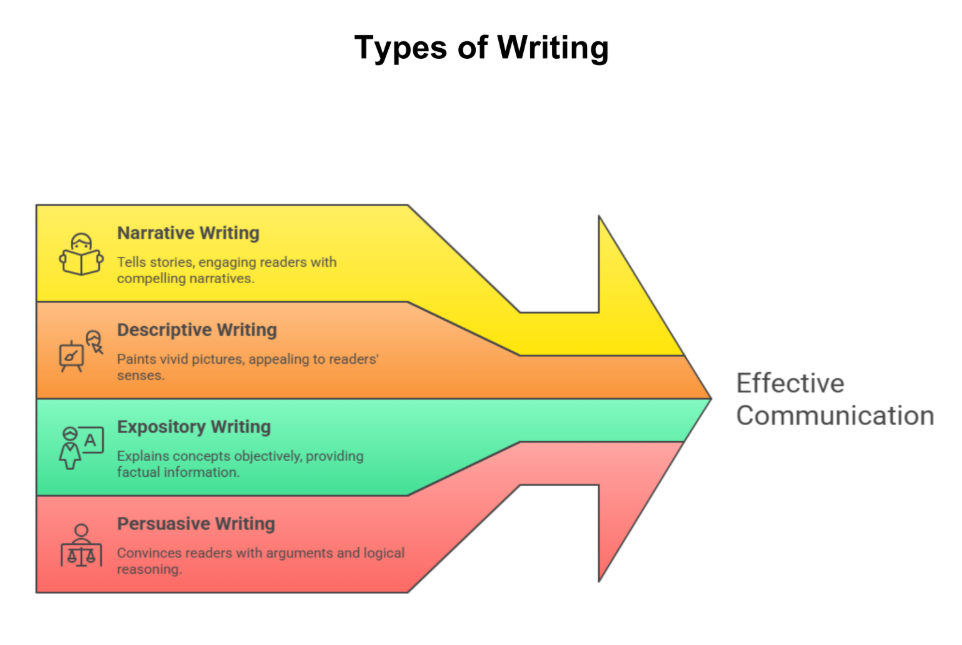
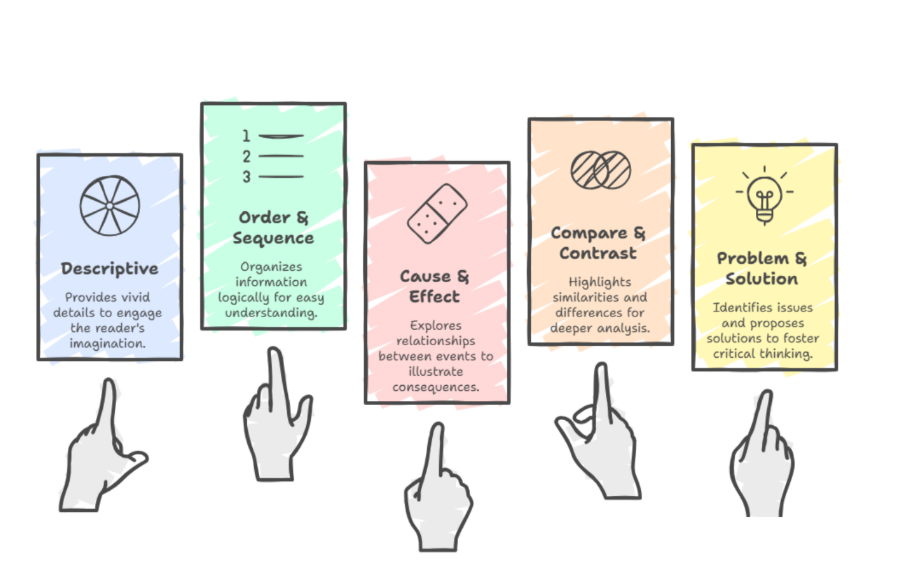
Reading and writing live across all levels and all contents. Why is the language of teaching reading and writing different in each department at the secondary level? Why do students hear about the types of writing, structure of non-fiction texts and close reading in English classes, but when required to tackle similar tasks in social studies, experience different language (or no nomenclature at all)?
Below, are three easily agreed upon common models/languages that can be used in any secondary school across all departments when working with students on literacy assignments.
Idea 3: Reading Apprenticeship: Talking to the Text
As for reading instruction, beyond returning to basic fundamentals of reading part-time, we can use the centuries-old process of apprenticeship. Experts read differently than novices. Our experts (educators) need to teach via a cognitive apprenticeship with students as they tackle complex texts. The idea of a “reading apprenticeship” is teachers thinking out loud as they model the reading process whileexplaining their thinking, strategies and habits. Students learn to “talk to the text” as they read, transforming the classroom into a safe place to struggle with text comprehension and discussion difficulties. Like true problem-solving in the math or science classroom, reading comprehension, particularly with complex text, isn’t a linear, algorithmic process. Instead, it is an individualized connection with the content to generate personal meaning when involving fictional text, and evidence-based meaning for non-fictional text.
I recall “talking to the text” of Wuthering Heights often in high school without having learned such reading strategies. Muttering, “WHAT??” was my singular question.
Idea 4: Genre Study to Support Reading of “The Classics”

Think about the logic of knowing many students are not reading at grade level then asking them to access and comprehend a classic noveland expecting them to enjoy reading and learning from their experience. Sigh–remember the Matthew Effect?
I’m not starting an argument about reading “The Classics” in high school but, as a principal, I witnessed a novel way to do it (See what I did there? 😉). I was fortunate enough to witness the implementation of a phase-in of a genre studies program in grade 9 through grade 12 English instruction over a multi-year period.
The results of the program were impressive. Library circulation was through the roof; student reading volume was up; student engagement in English class was improved; Lexile Scores had risen, and professional development and meaningful discussion around student literacy had become commonplace. I wish I could state the results were my doing but I simply watched, supported the leaders and instructional coaches, and fed the program funds (More on the power of Instructional Coaching next month.).
So what is genre study? Genre study can be an instructional unit, a course, or an entire curriculum. The teacher uses a mentor text (ex: Wuthering Heights) during classroom instruction, identifying curriculum based content such as literary devices.
Concurrently, students have select their own book in the same genre as Wuthering Heights—Gothic and/or Romanticism. More importantly, students select books in the same genre, but at or just above their own personal reading level based on current Lexile scores.
So, to oversimplify the beauty of genre study, embedded in discussions of this particular genre, the teacher identifies a literacy device such as “personification” used by the author of Wuthering Heights. After having students read a passage or two, the teacher explains personification by identifying the way the author gives the weather different human emotions. Students are then asked, either in classroom discussion and/or a written explanation, to identify the use of personification by the author of their personal gothic/romantic novel. Again, way oversimplified, but you get the idea.
This approach opens the door to many best practices in classroom instruction: student engagement, meaningful questioning, classroom discussion/debate, and student choice, just to name a few. Moreover, picture the transformation of the school media center to a genre-based arrangement of materials. An area of gothic novels, with a big display sign in dark gothic text. Other genres like fantasy, memoirs, mystery, dystopian, horror, all have similar display signs and distinct areas. In each genre area, books are shelved using colored bands based on Lexile scores and accessibility by present reading levels so that students can extend their reading rigor without being overwhelmed. Now that’s a school library (My apologies for Mr. Dewey)!
To quote a couple of folks who really know what they are talking about in the realm of literacy instruction:
- “Literacy is not just an ELA issue—it’s a schoolwide responsibility. Addressing the literacy gap requires instruction, not remediation alone." - Dr. Jaclyn Siano, Client Director, Inspired Instruction
- "The more that you read, the more things you will know. The more that you learn, the more places you'll go." - Dr. Seuss
______________________________________________________________________________________
For more in depth information on secondary school literacy and shrinking literacy gaps, join Inspired Instruction Client Director, Dr. Jaclyn Siano, on February 18th at 1:00PM EST for her upcoming webinar, “Closing the Literacy Gap for Secondary Students”


