
“AI is the new electricity.” — Andrew Ng, Founder of DeepLearning.AI
It was 1987 when I began my first teaching assignment with eighth- and ninth-grade math students. Fresh out of college, I had used a computer, word processor, and calculator for weekly assignments and tasks. Granted, the calculator was huge with only four functions, and one had to go to a special building on campus to access a computer. Still, I knew the days of looking up how to spell words, using typewriter correction tape, and doing long division were numbered.
But I soon found that wasn’t the case in schools. Computers and calculators were tools that some teachers used for productivity and efficiency. Students, however, continued without access to these innovations for many years.
A few years later, I learned that Seymour Sarason (1993) described schools as “intractable” when it comes to new ideas and change. He was correct—and still is…
Almost 40 years later, we are still teaching long division. Granted, understanding division (grouping) is important, and being able to divide a one- or two-digit number into a number 100 or less is part of a necessary skill set. But beyond that, is long division truly an essential skill for becoming a lifelong learner and productive citizen?
“You won’t always have a calculator handy,” I said—along with all my math teacher colleagues—for many, many years. Well, that didn’t age well…
So go ahead—start figuring out how many 17.25-pound bags of mulch can be filled from a 2,250-pound pile of mulch. I’ll wait…
We have seen similar patterns play out repeatedly in education as innovation attempts to reshape the learning environment: VCRs, laser discs (remember those?!), projectors/Smartboards, cell phones, Wi-Fi, one-to-one devices, learning management systems, and the internet. In each case, the educational setting has remained remarkably intractable.
Now, the next innovation challenging this resistance is artificial intelligence. Once again, under the banner of academic integrity, we educators risk positioning ourselves as the laggards on Rogers’ Diffusion of Innovation Curve.
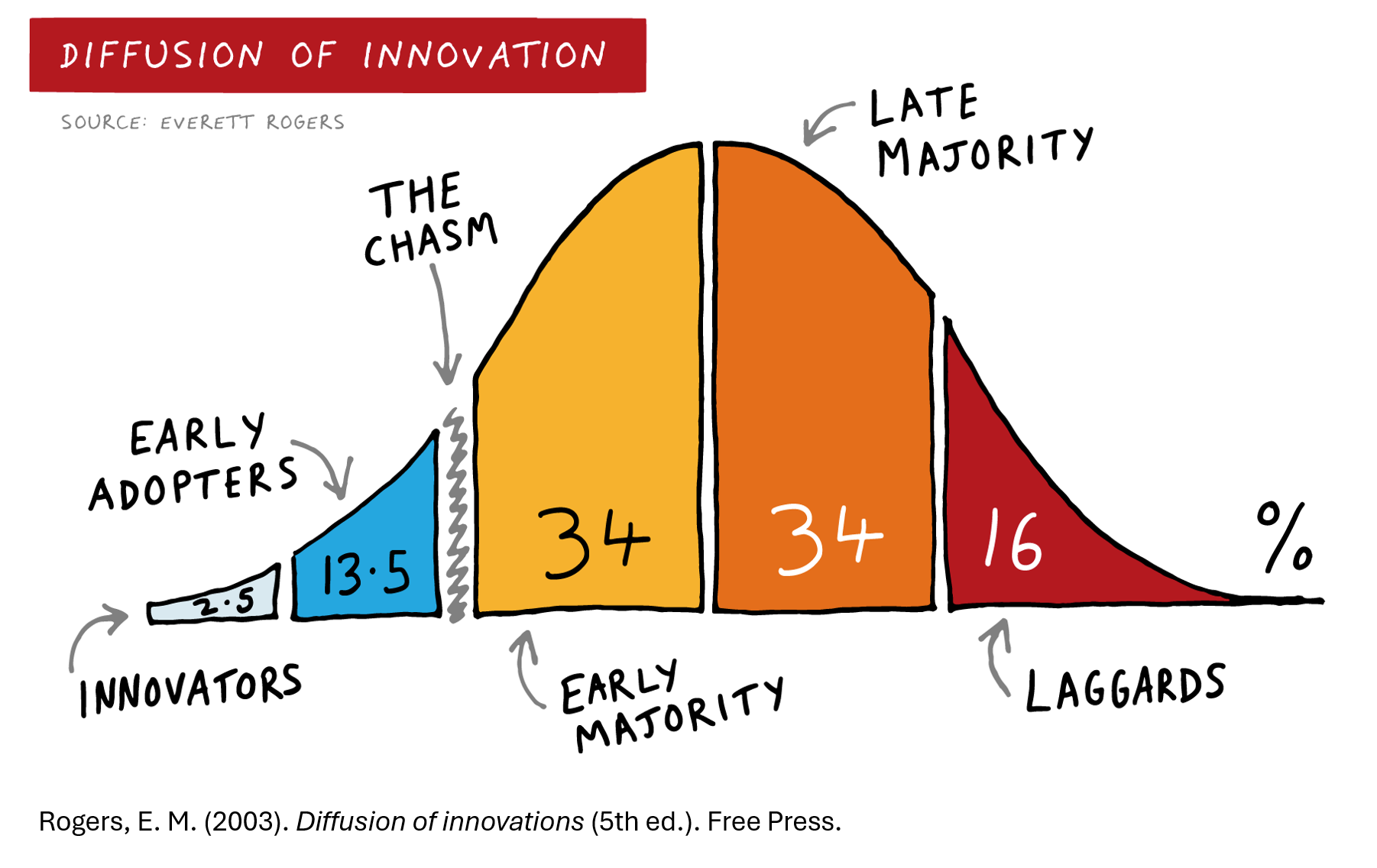
By definition, innovation makes things that were previously impossible possible—and things that were previously difficult much easier. AI is an equalizer. Those who couldn’t, now can. Those who could, now aren’t as special. I know—it stings. I once took pride in my internet search skills. Finding, analyzing, and evaluating information felt like a unique strength. Now, with AI, that skill is widely accessible. I’m less exceptional in this area as a result of AI (talk about regression to the mean…).
As my colleague Jessica Pingitore suggested in her blog AI: Are You Ready?, let’s “rip off the Band-Aid.” Let’s not force AI to endure the same long road to acceptance that calculators and word processors did in education. Our students see us as the preacher in Footloose, resisting a massive wave of innovation and new ideas. (Add it to your Netflix queue.)
If Andrew Ng is even partially correct—and AI is the new electricity—then we need to take a hard look at our academic standards, curricula, and instructional strategies, focusing on the future rather than protecting the past. (As I hope my medical professionals are doing with advances in medical science. “I don’t believe in anesthesia!” said no surgeon.)
An Idea and an Example
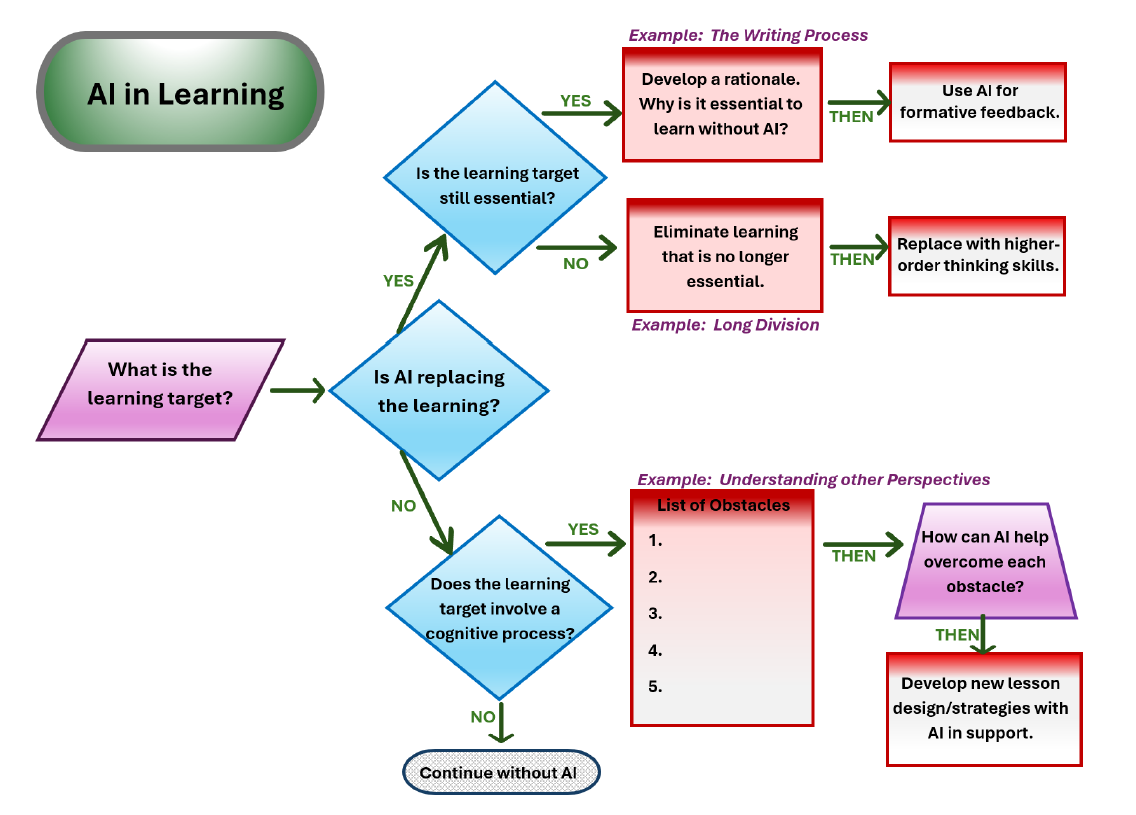
I believe there is a simple decision-making process when it comes to AI in learning. The first decision point is whether the use of AI replaces the learning embedded in the given learning targets. Consider three examples:
- The writing process
- Long division
- Understanding other perspectives
Let’s walk each of these through the flowchart.
The Writing Process
Yes, AI can replace the writing process. The next question is: Is the writing process still an essential skill to learn? I would argue yes—it remains essential and should not be replaced by AI. As a result, we need to develop a well-thought-out rationale for why writing remains critical, then publish, distribute, and advocate for it with all stakeholders. We should also teach students (and parents) how to use AI for real-time formative feedback without supplanting the revising and editing process.
Long Division
Yes, AI can replace long division. Is long division an essential skill in the twenty-first century? Beyond understanding grouping and applying the algorithm with one- or two-digit divisors into dividends of 100 or less, no. Let’s significantly reduce the time spent on this learning target and replace it with more meaningful, higher-order skills.
Understanding Other Perspectives
Consider this question: What was the perspective of British citizens 250 years ago during the American Revolutionary War? No, AI cannot fully replace this kind of complex understanding, which involves empathy, perspective-taking, and bridging a 250-year generational gap—all significant obstacles to student understanding beyond “taxation without representation.”
This is where AI is most powerful in the classroom: helping students overcome barriers to deep understanding of complex ideas. AI becomes a critical thinking partner previously unavailable at this level of accessibility—a skilled debater, a Socratic discussion facilitator, and a role-player offering differing perspectives. Creatively, it can serve as a brainstorming partner, a “what-if” researcher, and a sounding board for theories and solutions. Simulations and virtual experiments are limited only by imagination. All of this spans a boundless range of expertise—at our fingertips.
Try it yourself. Ask AI to debate you on a topic. For example:
Take on the role of a member of the British House of Commons in 1775. Debate me, an American colonist and future signer of the Declaration of Independence. I state, “We are being taxed without representation by the King!”
Try this or another topic—you may find yourself down a rabbit hole for hours.
Another powerful application of AI is in the realm of social-emotional learning. Choose your favorite SEL model and ask AI to generate prompts that support understanding of each skill within a given scenario. (Yes—ask AI to generate AI prompts.) My favorite model has always been the Habits of Mind—16 intellectual dispositions.
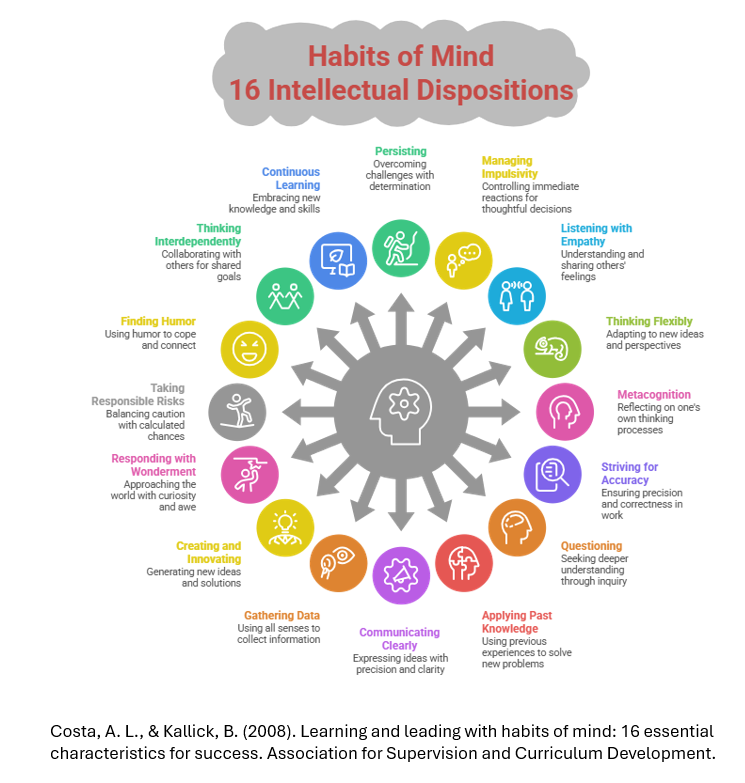
Looking for prompts to support the application of each of these skills? Check out the collection found in this two-page downloadable resource.

Just think about AI’s potential to advance student understanding and success. The possibilities are boundless—and constantly evolving. Let’s not be laggards with this innovation. Let’s move forward along the innovation curve. Embrace change. Protect what truly matters, let go of outdated practices, and experiment, collaborate, and iterate on ways AI can help overcome barriers to deep learning.
130 bags of mulch weighing 17.25 pounds each—with 7.5 pounds remaining. I used the calculator on my phone.
Now… can we finally get rid of long division? 😉
(Wait… 7.5 pounds left in the pile… how did…?)