


“With malice toward none, with charity for all.” - Abraham Lincoln
Happy New Year! May 2026 bring you peace, laughter, and strength–both personally and professionally.
The new year is often associated with new beginnings and resolutions to change things for the better. As we reopen schools after the winter break, we not only can address new starts for ourselves, we also control the opportunity for new starts for others. As teachers, we have the ability to give students a new beginning in the classroom. As principals, we not only can do the same for students but also staff.
Abraham Lincoln captured the idea in a concise phrase, “With malice toward none, with charity for all...” To that end, you have the power to eliminate malice and extend charity in your sphere of influence!
Toward Yourself:
- Let the past go. Past mistakes are just that, past mistakes. These mistakes are part of your learning experience. Other than that, they’re no more important and relevant than your outfit in your seventh grade school picture. Let the past go!
- The “Slide and Can” Maneuver. We create some of our own stress. We set our own standards. We establish the list of important things to do. We can rethink all of this at any point. Why not now? So, you know that pile of papers on your desk you haven’t gotten to yet? Slide it to the edge of your desk and push it into the trash can. I give you permission! That physical or mental “Things To Do List”? Cross stuff off that isn’t getting done. I give you permission! Skip the oil change this time. I give you permission! Slide and can it!
Toward Others:
- Malice toward none. Just like your past mistakes, let any ill-will and past grievances toward others go. Don’t necessarily forget the action that caused the feeling, but don’t let it rent space in your head. You’re punishing yourself! Mentally, “slide and can it.”
- Charity Through Amnesty. Put your empathy cap on! Of all those students under your umbrella, who could use your help with their “New Year, New Start?” We, as educators, created many of the procedures in our professional setting. It is in our power to alter and adjust such procedures.
Principals, find that student who owes you seven detentions? Cut them a “stay and a deal.” “Stay out of my office in January, I will eliminate the detentions.”
Teachers, find that student who is sitting at a 17% with five weeks left in the marking period and give them a genuine fresh start in January. Offer a simple path forward: complete all homework from now through the end of the marking period, and their grade will be adjusted accordingly.
Yes, some may argue that this isn’t fair to others or that it doesn’t teach responsibility. But what does allowing a student to remain trapped in a cycle of failure actually teach? Futility? Disengagement? Bitterness toward school?
Differentiation means giving students what they need to succeed, not treating every situation as identical. Offering a reset isn’t lowering expectations—it’s using your professional judgment to break patterns that no longer serve the learner. Extending grace is within your power, and it can change the trajectory for a struggling student. I give you permission!
Reset Your Classroom Environment
“The best time to plant a tree was 20 years ago. The second best time is now." - Chinese Proverb
Tree talk aside, the best time to reset your classroom management plan is in September. The second best time is in January.
“Don’t smile until Thanksgiving!” This was common classroom management advice given to me during my early years in the classroom. The adage paints the landscape prior to the shift in the classroom environment over the last several decades. While it is important to lay a foundation for a well-run classroom early in the school year, the advice also hints at a very rigid, and somewhat unwelcoming, coerced setting. (Picture a stern-faced teacher looking over half-framed glasses holding a ruler as students quietly work individually in neat rows of desks). Such a classroom would be considered structured and well-behaved, but would lack some very important attributes we now know make a classroom more conducive to learning. It remains important to have a focused plan early–beginning on the first day–as the classroom environment, once lost, is very difficult to get back. However, Classroom Management Theory began to undergo a shift in the late 1980s from coerced compliance to a more collaborative, proactive student-teacher approach with Lee Canter’s Assertive Discipline and other ideas like restorative practices, the responsive classroom model, MTSS, and school-wide positive behavior support programs.

It's okay to smile!
Research now clearly articulates classroom management philosophies that facilitate the learning process. Specifically, John Hattie states that one disruptive student can negate learning for all students in the classroom. In Hattie’s view, “It’s not about controlling students; it’s about creating the conditions where students control themselves.”
While there is still a place for structured disciplinary consequence plans, such if-then philosophies have a secondary role to more proactive, positive approaches to improving classroom behavior.
Research in Support of the Importance of Effective Classroom Management
The meta-analysis research of Robert Marzano, and more recently John Hattie, back the instructional effectiveness of well-implemented classroom management plans and their components. Specifically, Hattie’s meta-analysis assigned an effect size to over 200 factors influencing student performance in the classroom. The vast majority of these factors can be considered instructional strategies. Briefly, effect sizes range from negative numbers to 1.00. A 0.0 effect size indicates the strategy has no impact on student performance in the classroom. His analysis determined that almost all instructional strategies have a positive impact on student performance while the average effect size is 0.4. Hattie argues that educators should focus on high yield instructional strategies above the average effect size of 0.4.
To the topic at hand, Hattie’s analysis assigned the above average effect size of 0.52 to well-implemented classroom management plans. More specifically, teacher-student relationships (0.72) and time on task (0.62) have significantly better than average effect size assignments. Interestingly, Hattie identifies that the presence of one disruptive student had a negative effect size, interfering with the performance of the entire class of students.
The importance and research in support of well-implemented classroom management is clear.
Troubleshooting Classroom Management Issues
The gap between “knowing” and “doing” is sometimes vast and difficult to identify. So reflect on the essential questions below to assist in resetting your classroom management in January.
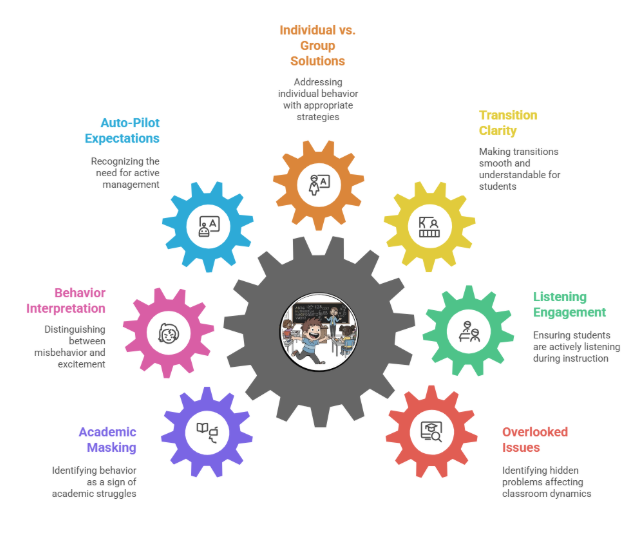
Essential Question: What are you not seeing?
Ever try to fix your own golf swing or the like? It’s next to impossible. Step back and view yourself and your classroom from “the balcony.” Identify the times, activities and circumstances when classroom management issues frustrate you. This is also a great opportunity to ask a colleague, coach, or principal to sit in to help identify such things. There’s no shame in being reflective and collaborative! Teacher collaboration remains one of the most effective paths to improvement in classroom practices.
Once you have identified some specific times, activities and circumstances, focus on improving one thing at a time. Solve it, then move on to the next. Think small, incremental improvements.
Essential Question: When you are speaking, who is truly listening?
There is nothing more humbling than looking over your classroom after saying something important and then realizing that absolutely no one was paying attention to what you said. (It’s okay to laugh at yourself!) Just because the class is quiet, doesn’t necessarily mean all are listening and understanding. Are you talking over the conversations of students? If so, stop! That mode never works. Eventually, you begin to sound like Charlie Brown’s teacher. (Google it!)
Can you make eye contact with each student when you’re speaking? If not, begin insisting on it! “When I am talking, your eyes should be on me or the board. If I move around the room, your eyes should follow me.” Pause and wait until all eyes are on you.
Essential Question: Are you identifying the changes in classroom expectations and checking for understanding as you transition between activities?
As with academic content, students need to be taught classroom behavioral expectations. No different than reading, writing and arithmetic, the teaching of behavioral expectations should involve checks for understanding and remediations/interventions as needed. Think MTSS, but with classroom expectations as the measurable learning target. Use data for whole-class reminders and/or remediations, then narrow the target audience to those still struggling with the expectations for more intense level 2 or level 3 interventions.
Essential Question: Are you treating individual student behavior issues with whole class solutions/reprimands?
No one likes to be called out in front of a group of peers. While certain egregious behaviors must be addressed promptly for all to see, most do not. When the infraction can be tolerated in the short term, find a one-on-one way to address the student. Let the student “save face” with their peers. This will build rapport and prevent an unwanted escalation, potentially making the issue more serious than it was previously. And if a situation ever escalates, never let yourself get into an argument with a student; assuming safety isn’t involved, better to just walk away and discuss the matter later in private at the first opportunity. Maybe establish a signal to let the student know you have noticed the behavior and will speak with them later.
Essential Question: Are you expecting your classroom to run on auto-pilot?
Classroom management involves the teacher’s active participation. Like barbequing, never leave the grill unattended; never leave the classroom unsupervised. And by unsupervised, I am not only talking about stepping out of the room for a moment. An unsupervised classroom includes when the teacher is sitting at their desk multi-tasking on other seemingly more important tasks. Active classroom management involves the teacher’s constant participation by circulation around the classroom, a high level of situational awareness and continuous individual student interactions. Proximity to students can prevent and fix many issues without so much as a word.
Essential Question: Is the behavior truly negative or simply adolescent excitement?
This is a critical question. We have too many unhappy kids and students who don’t like school. Disciplining a student for being happy and excited to be at school with friends runs a major risk of changing what is ultimately a positive attribute. Such discipline can have a deep and lasting impact on the student’s mindset about school. An excited child in the classroom is simultaneously a thing of beauty and terrifying. Overly excited students are prime for a positive relationship with the teacher. These students will thrive on attention.
Essential Question: Is the student’s behavior masking academic deficiencies?
In the mind of a child (and many adults for that matter), “fitting in” with others is the primary aim and controls a significant amount of time whether consciously or otherwise. Why does a student continuously “forget” their sneakers on the day of PE class? Poor organizational skills? Or avoiding the activities in PE class because such activities highlight physical differences? Why doesn’t a child want to go to school? School-phobia or family issues? Or do they feel their clothes or hair style doesn’t fit in? Why is a student misbehaving in the classroom? In need of discipline? Or deflecting attention from their inability to read, write, or do arithmetic?
The answers are rarely definitive and readily apparent. As with a doctor diagnosing the cause of a patient’s condition, teachers are tasked with diagnosing the causes of student behavior (albeit with significantly less resources at their disposal).
Enduring Understandings
Classroom management frustration is among the top concerns rivaled only by workload stresses of those in the teaching profession. It is the number one issue with teachers new to the classroom. It takes a daily emotional toll and undoubtedly is a significant contributor to teacher attrition. Never take students’ actions personally. Embody the following enduring understandings:
1. Classroom management is an essential element of effective teaching, not separate from it.
2. While the student’s action is frustrating and disruptive, the student has value and is worthy of your time and support.
3. Student classroom behavior is the product of individual student’s needs and the teacher’s actions/lack of actions.
Strive for a Smile
While there are no tricks or hacks to eliminate classroom management frustrations, I humbly offer the same advice I received from a mentor nearly 40 years ago. To face the day-to-day, hour-by-hour, minute-by-minute frustrations in the classroom, place two chairs in the back of your classroom. As you make the thousands of decisions required of you daily, look to those chairs as if both have an occupant. In one sits your most admired colleague. In the other chair, the parent of the child you are about to address. Make your decisions such that both occupants give you a nod of approval and a smile with your course of action. And specifically, when it comes to classroom management decisions and frustrations, find a way to give yourself and the student involved a reason to smile as a result of the interaction.
A smile can fix a lot!
Here’s a wonderful and simple new year’s resolution—smile more!
”If you don’t like the road you’re walking, start paving another one.” - Dolly Parton
________________________________________________________________
For more on resetting routines and expectations in the new year, join Inspired Instruction’s Director of PD Specialist Success, Odette Falone, on January 28th at 1:00PM EST for a review of the Pillars of Effective Classroom Management in her upcoming webinar, “New Year, New Momentum: Implementing a Classroom Management Tune-up.” Register here!


