
Re-Culturing September: “So, how was your first week of school?”
"You never get a second chance to make a first impression.”
~ Will Rogers
In the competitive business world, company leaders ask, "Do we have an image problem? Do we have a client satisfaction problem? Do we have an employee morale problem? Do we have a product quality problem?"
Schools, on the other hand, with a captive market and essentially a guaranteed revenue stream, rarely ask similar questions. Is our name and imagery proudly displayed? Do parents brag about our school when talking with others? Is our staff productively engaged, supported, and committed? Are students successful in their chosen path after they leave us?
Again, like a successful business, successful schools are a function of quality and perception among students, parents, and the community. One can argue the degree to which each element contributes to the function of success. Understanding that either quality or perception can dominate the function is important, but only for a period of time. If a school's success is fostered solely by perception, perhaps through a past legacy or a siloed program (sports), there are eventually empty promises.
Conversely – and perhaps a bit controversially – success built solely on quality tends to be dominated by rules, procedures, and policies to ensure desired outcomes. In my opinion, it is here that schools lose significant student, parent, and community support, as well-intended rules, procedures, and policies promote an unintended negative perception of the school. How important is enforcing the Lateness to School Policy to the minute? (Rhetorical)
I am not arguing for the elimination of rules, procedures, and policies. However, I am suggesting that we lead by bolstering a positive perception of our school before addressing such necessities—particularly in the form of consequences.
In our pursuit of quality and effectiveness, we unintentionally fail on the perception side of the equation.
The Perception Goals
• Parents speak positively about our school during daily conversations with friends, family, and neighbors; maybe they even boast or brag about it.
• Students have a positive experience during the first week and month of school.
• Staff are energized, enthusiastic, and proud of their efforts that are making a difference in the lives of young people.
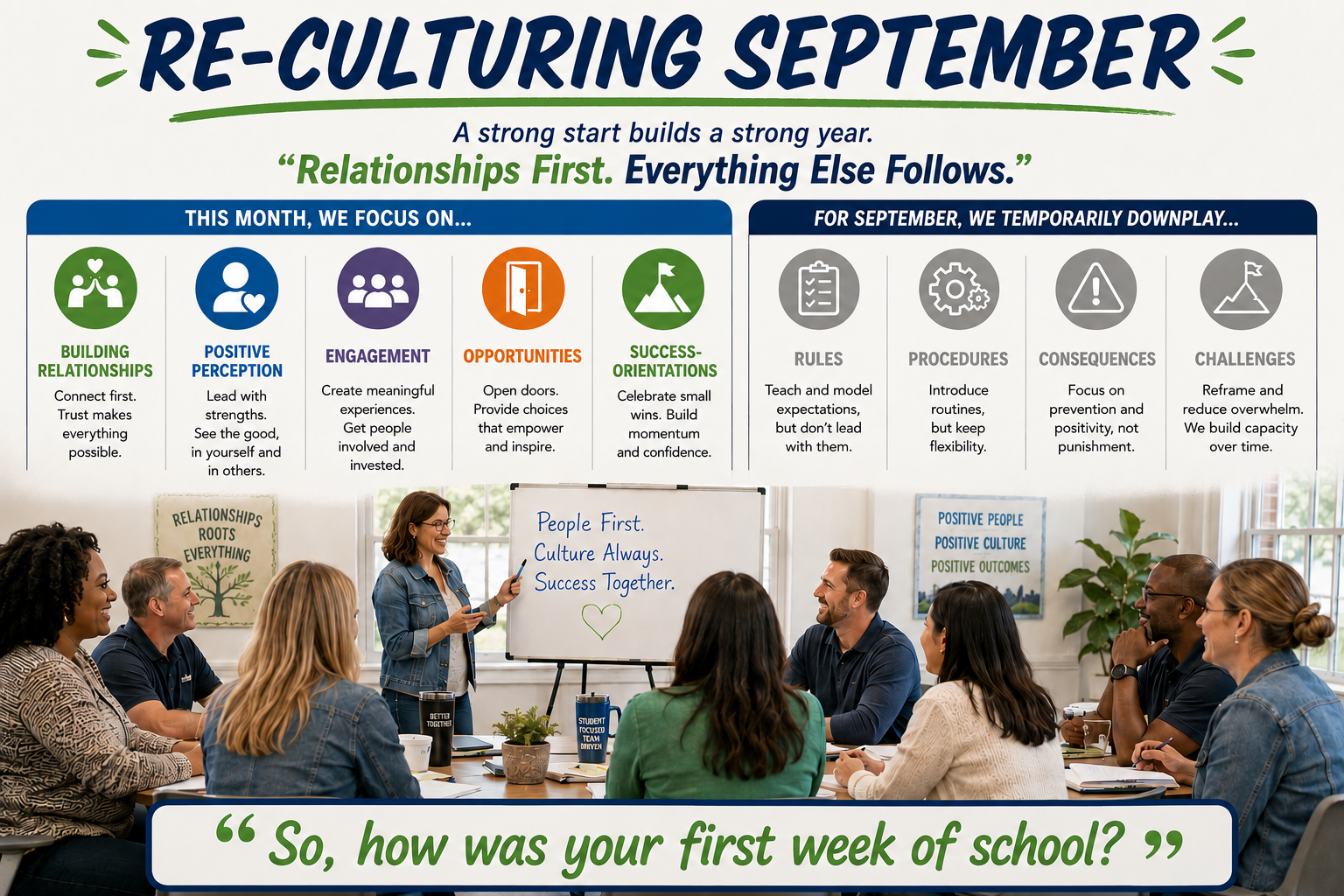
Research aligns closely with these ideas. An emphasis on positive first impressions, relationships, engagement, opportunities, and success before an intensive focus on rules and procedures reflects many of the conditions associated with stronger student perceptions of school. Research indicates that when students begin the year feeling welcomed, valued, and connected, they are more likely to experience success throughout the year.
How to Begin? Start Day One with Your Staff.
"The best time to plant a tree was 20 years ago. The second-best time is now."
First-Day Faculty Meeting
If we need students to experience a positive first week and first month, we have to facilitate the same experience for staff. Review the agendas of past first-day faculty meetings. What causes staff energy, positivity, and engagement to decrease? Understandably, some topics cannot be eliminated, but they can be postponed and added to the agendas of future meetings. Reduce such topics to a single slide titled Challenges on the Horizon to address in the near future. Acknowledge their existence, then refocus on the opening-of-school energy, engagement, and positivity.
No test scores. No problematic issues. No new mandates yet. Isolate your staff from these things in the short term so they can focus on the Week One goals with students; focus solely on the students' experience. Celebrate staff. Support new teachers and staff.
Watch for “End-Arounders”
And watch for “End-Arounders.” These are well-meaning leaders operating just beyond specific school environments: Student Services Personnel, Curriculum and Instruction Staff, Assessment Staff, and Compliance Personnel. Each can ruin the mood in a department or school with a single, poorly timed email, directive, or initiative. As you lead the people in your immediate charge around student and parent perceptions in September, also lead those at your level and above in supporting the same mission. Coherence is essential.
Support Staff Too!
And when was the last time you had a meeting with your support staff? Adults in the school see a clear distinction between certificated staff, paraprofessionals, and other support staff, but those outside the school do not normally see the difference, particularly in the classroom setting. Yet the bus driver, cafeteria worker, and custodian impact student perception of their school as well; in some cases, more so than teachers. Do each of them understand the perception goals and expectations for students' first week and month of school?
First Day with Students
“So, how was your first week of school?”
How do you want students to answer that question? Prepare as if each student's answer is of great importance, because it is. Prepare as if each of you can influence that answer, because you most certainly do.
Consider adjusting your first-day plans. Make your plans fun and engaging. Make questions relevant, thought-provoking and connected to the curriculum. Help students smile. Help them interact with one another. Postpone discussions about rules, procedures, expectations, and the 20-page course syllabus until later, after the positive perception has been solidified.

The world is (still) a mess on so many fronts—no need to list them. Each impacts individual students differently. We, as institutions of learning, have the ability to support students on all such fronts. If you haven't figured it out yet, it's not just about reading, writing, and arithmetic anymore. School needs to be a happy and safe place.
Month of September
Focus on enjoyment, opportunity, potential, and building relationships. Personally ensure all questions are answered. If you can't help, physically deliver the student to someone who can. No shuffle or answer scavenger hunt. Questions get answers.
Ensure each child's life is influenced in a positive direction each and every day. It is our daily work, and we, collectively, do it well. Whether it be saying "Hello" to a child as they get on your bus, acknowledging students in our hallways, or pulling a student aside after class to demonstrate that you care, each interaction builds a relationship. Each relationship improves their world, our school, and the world.
Phase in important rules, procedures, and policies after permitting some forgiveness and amnesty during the first month of school.
Goal: When consequences are received, students and parents quietly acknowledge, "Well, they gave us enough chances and opportunities to avoid it...."

Back to School Night Make-over
While we are at it, let's make-over Back to School Night. Don’t change the schedule, structure or organization, that will cause too much anxiety. Instead, ask your teachers to adjust their content for BTSN in its existing format. Imagine sitting through short presentation after presentation where teachers talk about rules, procedures and expectations. Blah… Ask your teachers to think similarly to the first day of school with students and present what is exciting about the content. “Go live” with an essential question: “What could the founding fathers not have foreseen when framing the Constitution?” An experiment and demonstration illustrating a key concept of biology, chemistry or physics. A particular example where algebra is useful! Don’t say, “Students will learn a system of equations.” Show how a system of equations helps the decision-making of what age to take social security. It is a system of equations with an intersection and change point of profitability as lines intersect. Crazy! Do something fun with your content. Be memorable!
Beyond establishing expectations, September sets the tone for the rest of the school year in terms of perception. Long after students forget your opening announcements, they will remember how the school made them feel. As leaders, our greatest opportunity isn't simply launching another school year – it is intentionally shaping the experiences that define it. Let's make certain every student has a "great" return to school.